
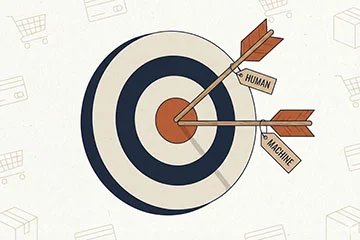
Agent buying presents a familiar problem to e-commerce merchants in a new form.
The promise is simple enough. AI agents act on behalf of shoppers to search, compare, select and even buy products. These agents will use shopper preferences (stated and inferred) rather than browsing products from digital shelves.
McKinsey & Company describes it this way: “Companies have spent decades refining consumer journeys, fine-tuning every click, scroll and tap. But in the era of the sales agent, the consumer no longer travels alone. Their digital proxies now run through the business ecosystem.”
2 goals

E-commerce marketers will focus on both humans and artificial intelligence in the age of agency commerce.
In effect, this means that e-commerce marketers have two targets: the human and the machine.
It’s a familiar scenario. Marketers seeking organic traffic have long searched for shoppers and appeased machines such as search engines.
An online pet supplies company wants Google to put its drip-free water bowls at the top of search results and get people to click on the listing.
In much the same way, this retailer now wants an AI-powered shopping agent to offer a drip-free bowl when a consumer asks the genAI platform how to stop a Doberman puppy from splashing water all over the kitchen.
This two-pronged approach paints a useful picture as many e-commerce companies wonder how they will manage sales when chatbots are making most of the purchases.
Marketing to Machine
For marketers, the most important component – buying agents – will likely come through platforms.
Few e-commerce businesses integrate their catalogs directly into each LLM or buying agent. Instead, trading platforms and marketplaces will be intermediaries. Merchants once publish structured product data and let these intermediaries distribute it to agent ecosystems.
This is already happening. Shopify, for example, is building a shopping infrastructure that allows agents to tap merchant catalogs and build carts.
Marketplaces will play a similar role. Amazon and Walmart already serve as product discovery tools and have no incentive to relinquish that position.
The recent dispute between Amazon and Perplexity over agent purchasing tools underscores how aggressively marketplaces can defend their infrastructure and customer relationships.
The implication for e-commerce merchants is practical. Marketing for machines will be a lot of work with structured data. Product sourcing, catalog hygiene, and API-ready business systems will become part of the visibility strategy, just as technical search engine optimization was essential when Google dominated.
Marketing to people
Through agency business, marketers are trying to influence AI. The second tactic is influencing the person writing the challenge.
AI agents select products based on users’ stated needs and inferred preferences. So marketers have a clear goal: Shape what customers want, how they describe it, and which brands or stores they trust before they ask.
This is also not new. It’s like asking for a brand in Google search results. A shopper gets one set of results for “best dog bowl” and another for “best dog bowl without Chewy drips.”
In agency marketing, branding and preference setting become even more valuable as they drive shopper intent. And this intention in turn affects the agent.
Here’s how marketers exercise that influence.
Advertising. Social media and video ads promote familiarity, define product categories, and introduce specific terminology.
Over time, this language becomes rapid phrasing. A marketer doesn’t have to control the AI model, but they can control whether their product name, distinguishing feature, or problem statement becomes part of the shopper’s vocabulary.
Content marketing. Shopping guides, comparisons, and troubleshooting articles establish concepts that customers will later recall in challenges.
Personalized lifecycle marketing and email marketing can become even more important because they represent custom audiences and the opportunity to identify shopper preferences.
Business systems, including artificial intelligence, can use purchase history, browsing signals and customer data to predict needs and recommend actions. The better the trader is at sustaining, the more likely they are to influence the challenge. Or, for that matter, bypass him entirely.
Personalized Lifecycle Marketing emphasizes the individual, according to Matthew Fanelli, chief revenue officer at Digital Remedy. Shoppers, Fanelli said, are like snowflakes: beautiful and unique in their own way.
Marketing influencer is another prompt-former. Fanelli described this as a third point, driven by peer behavior and social proof. “What is my peer group doing? What are they buying? How do I reach them?” he said.
Fanelli expects a trio of forces to reshape e-commerce: more choice, shorter attention spans and more connected devices. “That’s when you start getting agents,” he said. For traders, the answer is not panic, but discipline. Create demand from people and structure data for machines.